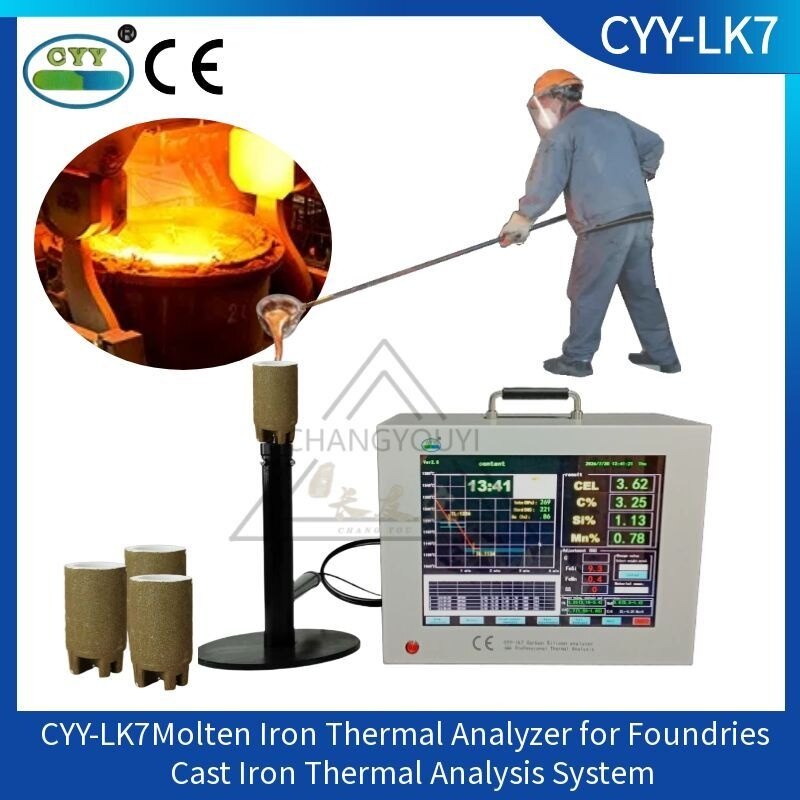
Most ductile iron batch variations originate not from the melting furnace, but from information gaps in the minutes leading up to it. Without real-time composition data for molten iron, operators must rely on experience and spark color analysis to adjust the charge mix. By the time chemical analysis and tensile test results are available, that batch has already been poured. CEL, C%, Si%, and Mn% each govern distinct critical properties: CEL determines solidification mode and shrinkage tendency; C and Si together dictate graphite morphology and matrix structure; Mn influences pearlite content and low-temperature toughness. When any parameter deviates from its target window, subsequent inoculation and treatment steps cannot fully compensate.
The thermal analysis casting analyzer correctly measures that void. The device does not measure the cast iron itself, but rather the latent heat released during solidification.
1. Cooling curve is another way of writing component
The process is straightforward: a sampling cup captures a ladleful of molten metal from the furnace, and thermocouples mounted at the bottom record the entire cooling curve. The system then back-calculates composition and microstructural trends based on the curve's features. Since liquidus temperature corresponds directly to carbon equivalent (CEL), CEL can be derived straight from the curve's inflection point. The flat region's temperature and recalescence degree reflect silicon content and inoculation effectiveness. Variations in the flat region's shape indicate spheroidization decay and shrinkage porosity risk.
Timing is critical. Spectral analysis requires sample preparation, excitation, and waiting for results; thermal analysis takes only a few minutes from pouring the sample to getting a reading, while the molten iron is still in the ladle. Decisions made within this window are valuable: should the composition be adjusted? Can this batch of iron be poured?
2. One device for simultaneous CEL, C%, Si%, and Mn% analysis
CYY-LK7 is an intelligent carbon, silicon, and manganese analyzer. Built on the same advanced technology platform as our expanded series, it delivers a single measurement for CEL, C%, Si%, Mn%, plus adjusted alloy composition, tensile strength, and hardness—integrating chemical composition and mechanical property predictions into one unified readout.
Supplemental Mn has practical value for ductile iron foundries. Manganese stabilizes pearlite; high levels reduce elongation and low-temperature impact values, while too low a level compromises strength. Adjusting based on lab results after the fact is too late. Predicted tensile strength and hardness allow operators to determine before pouring whether the iron charge meets the required grade specifications, without waiting for test samples.
The equipment is CE certified (certification number M.2026.206.C145544) and features a fully English control panel. For export-oriented foundries and overseas project sites, this ensures self-operated shifts and compliance documentation ready for customer audits.
3. A reader only generates a value when within the controlled range.
The pre-furnace reading is performed once during batching and process adjustment. The standard procedure involves three steps: before melting, use the base iron reading to calculate carbon and ferrosilicon additions; after refining and modification, re-sample and compare the CEL and Si% drift between readings to assess treatment stability; after tapping, record batch data for traceability and customer evaluation.
This process must be used in conjunction with temperature measurement. The handheld molten metal thermometer CYY-W330 and the large-screen liquid metal thermometer CYY-W600 handle iron temperature, while CYY-LK7 manages core composition and mechanical property prediction. Combining both data streams ensures a more stable furnace operation.
The challenge in molten iron control isn't a lack of equipment, but insufficient data to make decisions before pouring. With CEL, C%, Si%, Mn% displayed alongside strength and hardness on a single screen, rework and scrap rates shift from probabilistic issues to manageable management tasks.
4. About Changyouyi (CYY)
Nanjing Changyouyi Analytical Instrument Co., Ltd. is a manufacturer of casting test equipment and metal analysis instruments, integrating R&D, manufacturing, sales, training, maintenance, and technical support. Our product portfolio includes molten metal temperature meters, carbon-silicon analyzers, thermal analysis systems, spectrometers, and laboratory testing equipment. Core products carry CE certification and feature fully English control panels. They serve steel mills, foundries, machine shops, and quality inspection labs, backed by over a decade of experience in pre-furnace testing for the casting industry.
Choosing between a thermal analyzer or a carbon/silicon analyzer depends on your foundry's iron conditions, inoculation process, and target grade; the spec sheet alone can't answer everything. For detailed specifications and application recommendations for CYY-LK7,, please contact our technical team with your actual operating conditions so we can provide a tailored solution.